
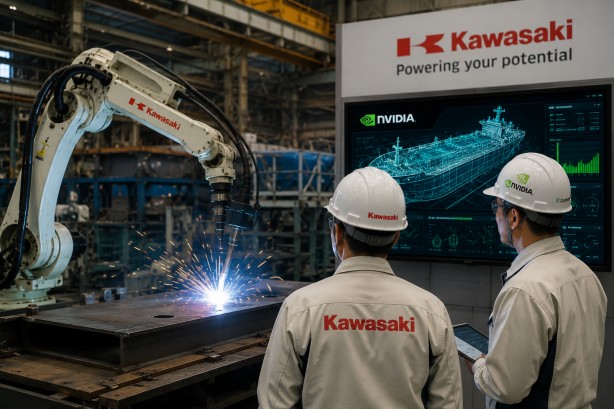
Nvidia has teamed up with Japan’s Kawasaki Heavy Industries in a bid to revolutionize shipbuilding through the integration of AI-powered robotics. This collaboration aims to bring modern digital technologies and automation to the forefront of the industry, enhancing efficiency in the creation of ships. The focus will be on developing robots capable of executing tasks such as welding, painting, inspection, and material handling. These robots will be a part of a cutting-edge digital shipyard that leverages both physical AI and digital twin technology.
The collaboration between Nvidia and Kawasaki Heavy Industries is poised to tackle Japan’s pressing labor issues. With an aging population and a dwindling number of skilled workers, the country’s shipbuilding sector faces a significant labor shortage. By introducing advanced robotics and automation, the partnership aims not only to boost productivity but also to support the development of environmentally friendly ships, including low- and zero-carbon vessels.
In the context of this significant partnership, Nvidia CEO Jensen Huang recently visited Tokyo, where he took a moment to acknowledge the pivotal role Sega played in Nvidia’s early days. He expressed gratitude for Sega’s $5 million investment in the 1990s, which he credited as instrumental in helping Nvidia survive during its challenging early years. This nod to the past highlights the importance of strategic alliances in advancing technological innovation.
This initiative between Nvidia and Kawasaki is a testament to how industries are increasingly turning to digital solutions to address contemporary challenges. By merging advanced robotics with the shipbuilding process, the partnership seeks to not only streamline operations but also pave the way for a more sustainable future in maritime construction. The use of AI and digital twin technology is expected to transform traditional shipbuilding methods, making them more efficient and environmentally responsible.