
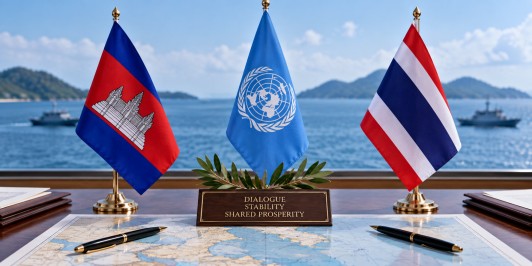
Cambodia and Thailand have embarked on a conciliation process supported by the United Nations to address a protracted maritime boundary conflict in the Gulf of Thailand. This initiative is under the framework of the United Nations Convention on the Law of the Sea (UNCLOS), with foreign ministers from both nations making opening remarks at the inaugural meeting. Cambodia aims to establish a definitive maritime boundary with Thailand, whereas it has also suggested a joint development strategy to allow resource sharing in the contested region.
In contrast, Thailand has insisted that the discussions concentrate solely on demarcating the maritime boundary and has reiterated its commitment to participating earnestly in the process. Previously, Thailand had advocated for resolving the issue through bilateral negotiations. The dispute involves about 26,000 square kilometers of ocean territory that is thought to be rich in natural gas and oil deposits, lending significant economic weight to the conflict.
Back in 2001, both countries reached an agreement to collaboratively develop the resources in the disputed area. However, this arrangement came to an end in May, following heightened tensions due to deadly skirmishes along their land border. This prompted Cambodia to initiate the compulsory conciliation process under UNCLOS in June.
The independent panel overseeing this process can offer recommendations, though these are not legally binding for either party involved. The conciliation effort represents a significant step in attempting to resolve a dispute that has spanned over a quarter of a century, with potential implications for energy resource management in the region.